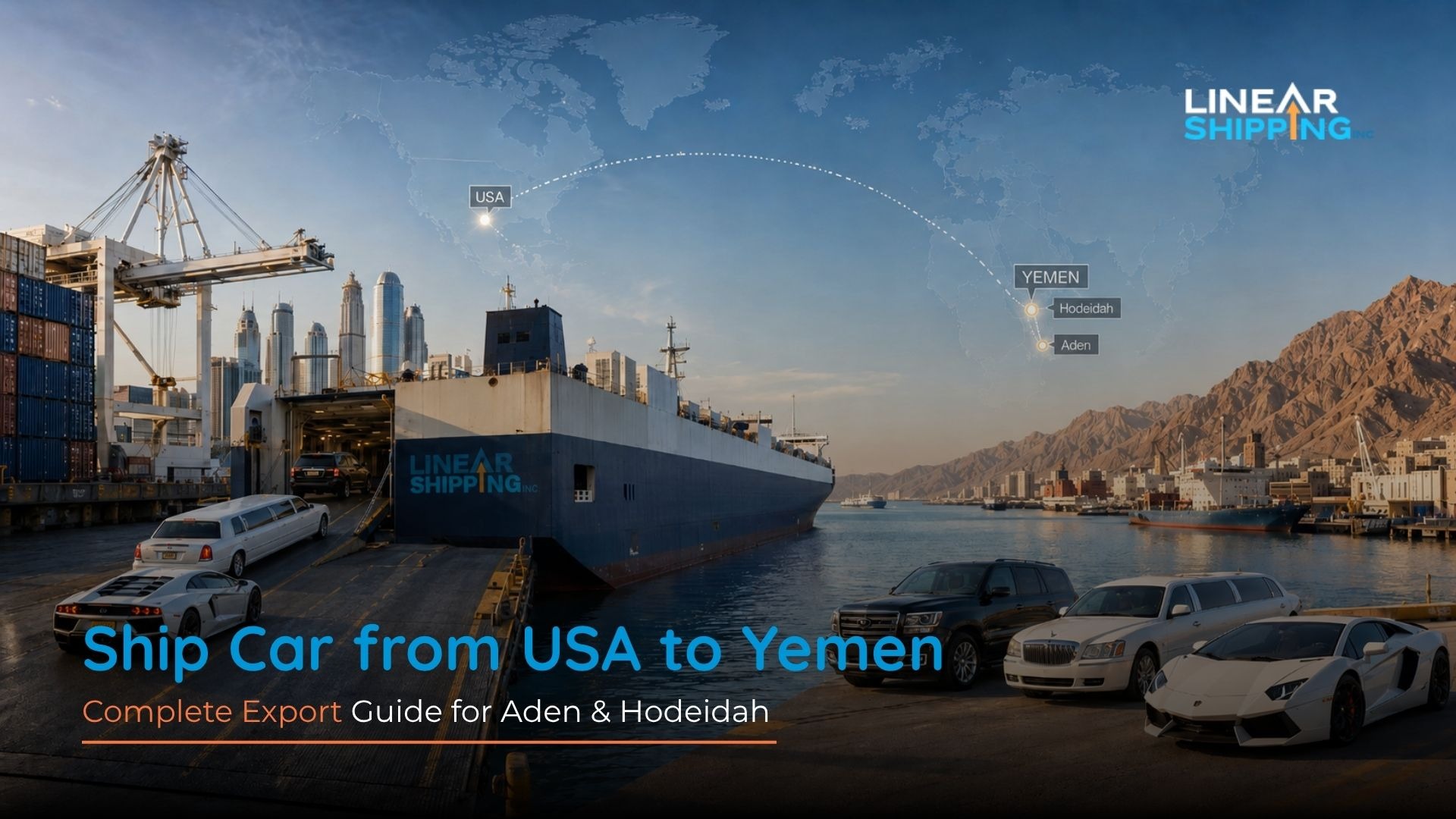
Shipping a car from the USA to Yemen is possible and follows an established container freight process from U.S. ports through regional transshipment hubs to Yemeni ports. Aden is the most commercially active and operationally reliable port for vehicle imports from the United States under current conditions. Hodeidah remains operational but is subject to ongoing conflict-related risk and capacity constraints as a Houthi-controlled Red Sea port. As of February 1, 2025, all containerized shipments to Yemen require an Advanced Cargo Declaration (ACD) certificate, with the ACD number appearing on the Bill of Lading before the vessel departs. Transit from U.S. ports to Aden is typically 25 to 40 days, depending on the transshipment routing through Djibouti, Salalah, or Gulf hub ports.
Yemen has maintained a consistent demand for imported vehicles throughout the past several years, even as the country navigates a complex geopolitical environment. The Aden commercial corridor continues to function as the primary gateway for commercial cargo, including vehicle imports, under the authority of the Yemeni government-aligned port authority. Dealers and individual buyers sourcing used vehicles from U.S. auctions represent a real and active portion of this import flow, drawn by American vehicle availability at price points that are competitive relative to alternatives available through regional markets.
The USA to Yemen lane requires more preparation than a standard Gulf destination. The port landscape is divided between government-controlled and Houthi-controlled areas, each carrying different operational realities and risk profiles. A documentation requirement unique to Yemen — the Advanced Cargo Declaration (ACD) — became mandatory in early 2025 and applies to every container shipment without exception. Marine insurance for Yemen-bound shipments carries different underwriting considerations than for more stable lanes. And the routing to reach Yemeni ports involves transshipment through regional hubs rather than direct vessel calls from U.S. ports.
Exporters who understand these requirements in advance ship without complications. This guide covers every practical aspect of the USA to Yemen vehicle export lane, written specifically for dealers, buyers, and freight forwarding professionals who are managing or planning to manage shipments on this route.
Linear Shipping is an FMC-licensed NVOCC and international freight forwarder with established carrier relationships on trade lanes serving Yemen through regional transshipment hubs. We manage the complete U.S. export process, coordinate with our regional agent network, and advise on the current operational status of Yemeni ports before each shipment is committed.
1. Yemen as a Vehicle Import Market: What Exporters Need to Know
Yemen’s vehicle market has remained active despite the ongoing conflict, driven by structural demand and the continuing function of the Aden commercial corridor. In 2024, the market recorded approximately 10,892 vehicle registrations, the second-highest annual total on record. The demand for used imported vehicles, particularly from U.S. auction sources, reflects the combination of accessible pricing, broad vehicle availability on U.S. platforms, and the practical transportation needs of both individual and commercial buyers in southern Yemen.
U.S. auction vehicles, including both clean-title and lightly salvaged sedans, SUVs, and pickup trucks from Copart, IAAI, and Manheim, are commercially viable in the Yemeni import market for the same reasons they perform well across other Gulf and Middle East destinations: American-market vehicles are priced competitively, the auction process makes large inventories accessible online, and the established shipping corridor from U.S. ports to Aden provides a reliable logistics pathway for experienced freight forwarders.
The commercial reality is straightforward: Yemen imports vehicles, Aden port handles those imports, and the process from U.S. auction purchase to Aden arrival follows a defined logistics sequence that an experienced freight forwarder manages without issue. What distinguishes this lane from a standard Gulf export is the preparation required at every documentation stage and the importance of working with a forwarder who understands the Yemen-specific requirements, including the ACD, current port conditions, and appropriate insurance arrangements.
2. Yemen’s Ports: Aden, Hodeidah, and Mukalla — Current Operational Status
Understanding which port your vehicle is destined for is the first and most consequential decision in planning a Yemen shipment. The country’s port landscape is divided by political and military geography, and the operational realities at each port differ substantially.
Aden Port — Recommended for vehicle exports.
Aden is the primary commercial port for government-controlled southern Yemen and the most operationally reliable gateway for vehicle imports from the United States under current conditions. The Port of Aden operates under the authority of the Yemen General Authority of Ports and Coasts (YGAPC), the government-aligned port authority. The port maintains certified marine pilots, tugboat and mooring capabilities, ISPS Code compliance, and has recently upgraded its Vessel Traffic Management Information System. Container operations are conducted at the Aden Container Terminal (ACT), which has implemented ERP systems and active cargo management infrastructure. Security Level 1, the most favorable classification, has been declared for Aden. The port maintains active engagement with international organizations including UNDP, UNODC, and IMO.
For vehicle exports from the United States, Aden is the port Linear Shipping recommends and coordinates for standard Yemen-bound shipments. All logistics planning, carrier booking, local agent coordination, and transit timing are structured around Aden as the default destination.
Hodeidah Port — Operational but not recommended for standard vehicle exports.
Hodeidah is historically the busiest commercial port in Yemen by volume and is the primary humanitarian cargo gateway for northern Yemen and populations near the capital Sana’a. However, Hodeidah is a Houthi-controlled Red Sea port and has experienced significant airstrikes and infrastructure damage. Red Sea ports under Houthi control have seen capacity reductions of approximately 70% as of 2025, with fuel imports through Hodeidah falling to their lowest level in four years in early 2026. While Hodeidah continues to operate for aid and some commercial cargo, it carries conflict-related risk that is not appropriate for standard commercial vehicle export shipments from the United States.
Exporters whose buyers specifically require Hodeidah delivery should discuss the current operational environment, insurance implications, and carrier availability with their freight forwarder before committing to this destination. Linear Shipping does not route standard vehicle export shipments through Hodeidah under current conditions.
Mukalla Port — Secondary commercial port, eastern Yemen.
Mukalla, located on Yemen’s eastern coast in the Hadramawt region, is a smaller commercial port with Security Level 1 status. It handles some commercial cargo and could serve buyers in eastern Yemen, though carrier frequency and vehicle import infrastructure are more limited than Aden. For most vehicle exports from the United States, Aden remains the practical default.
Salalah, Oman — As an alternative entry point.
Some Yemen-bound cargo, particularly when the final destination is near the Oman border or when port conditions warrant an alternative approach, transits through Salalah in Oman before overland or coastal delivery into Yemen. This routing is not typical for vehicle exports but is an option discussed in advance with consignees in specific geographic situations.
The port selection should be confirmed with the Yemeni buyer before the shipment is booked. For standard vehicle exports to Yemen, Aden is the operationally sound choice under current conditions.
3. Why Container Shipping Is the Standard Method for Yemen
Container shipping is the method that applies to vehicle exports from the United States to Yemen. This is determined by the trade lane structure, not by preference.
RoRo vessel service from U.S. ports to Yemeni ports is not available as an established, direct trade lane option. The Yemen route does not have dedicated Pure Car Carrier (PCC) vessel schedules from U.S. ports in the way that major automotive trade lanes to Dubai or Aqaba do. Container service, routed through regional transshipment hubs, is the operationally available method.
For the buyer considering whether this creates a cost or flexibility disadvantage compared to shipping to a more directly served destination, the answer in practice is no — container routing through Djibouti or Gulf hub ports to Aden is a well-established freight path with regular weekly service options. The total transit time and cost structure are comparable to other North African and Horn of Africa destinations served by container through similar transshipment patterns.
Container shipping also provides specific practical advantages for Yemen-bound vehicle shipments. The sealed container maintains cargo integrity from the stuffing facility through to Aden, which matters when the transit involves multiple vessel transfers. It accommodates non-running vehicles without the terminal-handling uncertainty that RoRo introduces for inoperable units. And it permits spare parts, accessories, or other declared items to travel in the container with the vehicle — an option that many Yemeni buyers specifically request for vehicles imported for commercial or working use.
A detailed breakdown of when container shipping wins over RoRo across all decision variables is available in the comparison of RoRo and container shipping methods for vehicle exports, which covers the full analysis relevant to this and other trade lanes.
4. How to Ship a Car from USA to Yemen Step by Step
Step 1: Auction purchase and pre-shipment title review.
After winning a vehicle at Copart, IAAI, or Manheim, send the VIN, lot number, auction invoice, and title information to your freight forwarder. A pre-shipment title review confirms title type, verifies the chain of ownership, and identifies any documentation issues before the vehicle enters the export pipeline. For Yemen, confirming that the vehicle’s description and value are accurately stated at this stage is particularly important, as the ACD and customs documentation are built from the same information.
Step 2: Inland transport and staging.
A licensed transport carrier picks up the vehicle from the auction yard and delivers it to the freight forwarder’s staging warehouse. For running vehicles, standard auto transport applies. For non-running vehicles, winch-equipped flatbed transport is required. Linear Shipping coordinates pickup from auction locations across the United States and stages vehicles at warehouses in Houston, Savannah, New York, and Los Angeles before container loading.
Step 3: ACD Certificate application.
This step is specific to Yemen and must be completed before the vessel departs. The Advanced Cargo Declaration (ACD) is a mandatory pre-shipment document for all containerized shipments to Yemen, effective February 1, 2025. The ACD number must appear on the Bill of Lading. The certificate is obtained at the port of loading by the shipper, exporter, or freight forwarder — the Yemeni consignee cannot apply on behalf of the exporter. Required documents for the ACD application include the Bill of Lading (draft or near-final), Commercial Invoice, and Freight Invoice. Processing typically takes 24 to 48 hours. Cargo arriving without a valid ACD number on the Bill of Lading faces penalties at the Yemeni port of discharge.
Step 4: AES/EEI export filing and ITN.
Every vehicle exported from the United States with a declared value above $2,500 requires an Electronic Export Information (EEI) filing through the Automated Export System (AES). The resulting Internal Transaction Number (ITN) must be obtained at least 72 hours before vessel departure. The full requirements, Schedule B codes, and compliance obligations for vehicle exports are covered in the AES filing guide for vehicle exports, which details every step of what CBP requires from the exporter.
Step 5: Container stuffing and port delivery.
The vehicle is loaded into a 20-foot or 40-foot container at the stuffing facility, secured with wheel chocks and lashing straps, and the container is sealed before departure. The container is then delivered to the export port terminal within the carrier’s cargo cutoff window.
Step 6: Ocean freight and transshipment.
The container departs from the U.S. port on an ocean vessel and transships through a regional hub — typically Djibouti, Salalah (Oman), or a Gulf hub port — before connecting to the vessel serving Aden. Transit from U.S. East Coast and Gulf ports to Aden via transshipment is typically 25 to 40 days.
Step 7: Arrival notification and Yemeni customs clearance.
On arrival at Aden, the local agent submits the customs entry documentation. Clearance requires the original Bill of Lading with the ACD number, commercial invoice, vehicle title, and consignee documentation. Duties are assessed and paid before the vehicle is released.
5. The ACD Certificate: Yemen’s Mandatory Pre-Shipment Requirement
The Advanced Cargo Declaration (ACD) is the most operationally significant Yemen-specific requirement that exporters and freight forwarders must build into their process. Failing to obtain and include the ACD number on the Bill of Lading before the vessel sails is not a minor oversight — it results in penalties at the Yemeni port of discharge and can hold the shipment until the documentation issue is resolved.
What the ACD is. The ACD is Yemen’s version of an advance cargo tracking document, also referred to in other countries as an ECTN (Electronic Cargo Tracking Note) or BSC (Bulk Shipping Certificate). It is issued at the port of loading and provides Yemeni authorities with pre-arrival information about the shipment: shipper and consignee details, cargo description, HS code, vessel information, and cargo value.
When it became mandatory. The ACD became mandatory for all containerized shipments to Yemen as of February 1, 2025, enforced by Yemen’s Counter-Terrorism Service under a directive from the Ministry of Transport. It applies to all containerized cargo without exception by cargo type or declared value.
Who is responsible. The responsibility for obtaining the ACD rests entirely with the shipper, exporter, or freight forwarder at the port of loading. The Yemeni consignee cannot obtain the ACD on behalf of the exporter. This is a U.S.-side pre-departure requirement that must be completed before the vessel sails.
What happens without it. Cargo arriving at a Yemeni port without a valid ACD number on the Bill of Lading may face penalties of double the certificate cost plus regulatory charges, delays in customs clearance, or in cases of significant non-compliance, seizure or confiscation of goods.
How it integrates with the booking. The ACD application requires the Bill of Lading (draft or near-final is acceptable), Commercial Invoice showing accurate cargo value, and a Freight Invoice. Processing typically takes 24 to 48 hours. The ACD number must be written on the final Bill of Lading before the ship sails. Linear Shipping manages the ACD application as part of the standard export process for Yemen-bound shipments, ensuring the certificate is obtained and applied to the Bill of Lading within the carrier’s documentation cutoff window.
6. Export Documentation Required for Yemen
The full document package for a Yemen-bound vehicle export from the United States includes both standard U.S. export documents and the Yemen-specific ACD certificate.
Original vehicle title. The title must be original, not a copy. The ownership chain must be complete and clearly documented. Yemen accepts clean titles, salvage titles, and rebuilt titles, though the specific title type should be confirmed against the consignee’s intended use and any local registration requirements.
Bill of sale or auction invoice. The Copart, IAAI, or Manheim auction invoice or the dealer bill of sale establishes the vehicle’s identity and purchase value. It is referenced in the AES/EEI filing and in the ACD application, and it forms the basis for Yemeni customs duty assessment.
ACD certificate with ACD number on Bill of Lading. Mandatory for all containerized Yemen shipments as of February 1, 2025. The ACD number must appear on the final Bill of Lading before the vessel departs.
AES/EEI filing and ITN. The Internal Transaction Number from the AES filing must be obtained at least 72 hours before vessel departure. Required for all U.S. vehicle exports with a declared value above $2,500.
Power of Attorney. Required if the freight forwarder is filing AES and managing the ACD on behalf of the exporter. Linear Shipping provides a standard POA template as part of the onboarding process.
Bill of Lading. Issued by the ocean carrier after the container is loaded. The Bill of Lading must show the correct consignee information matching Yemeni customs expectations, and must include the ACD number before it is finalized.
Commercial Invoice. The commercial invoice must describe the vehicle accurately — make, model, year, VIN, condition, and declared value. Accuracy on the commercial invoice is directly connected to the validity of the ACD application and to the customs duty assessment at Aden.
Consignee documentation. Yemeni customs requires identification documentation from the consignee. Whether the importer is an individual buyer or a commercial dealer affects which documentation format is required. Confirming consignee documentation requirements with the local agent before the vessel departs prevents the most common clearance delays on this lane.
7. AES Compliance and Yemen Destination Considerations
U.S. export compliance for Yemen-bound vehicle shipments follows the same core framework as any international vehicle export. The AES/EEI filing requirement, the 72-hour ITN deadline, and the Schedule B commodity code requirements all apply in the same way they apply to any other destination.
Yemen does not carry the same sanctions profile as some other North African or Middle Eastern destinations. However, standard practice for any international vehicle shipment involves confirming that the transaction does not involve any parties on U.S. OFAC Specially Designated Nationals (SDN) lists or BIS restricted party lists. This is a routine compliance step that any licensed freight forwarder conducts before confirming a booking. Linear Shipping conducts restricted party screening for all international shipments as part of the standard pre-shipment process.
A new mandatory requirement introduced in 2026 affects vessel operations: vessels entering Yemen must obtain a permit before leaving the port of loading and must keep AIS (Automatic Identification System) activated for the entire voyage to Yemen. This requirement applies to the carrying vessel, not to the exporter directly, but it affects which carriers are willing to commit to Yemen-bound bookings and influences the routing and scheduling options available for a given sailing.
Exporters should work with a freight forwarder that has current, active carrier relationships on Yemen-serving trade lanes. Carriers that have not fully adapted to the Yemen vessel permit requirement may not offer reliable booking options, making forwarder-level carrier access an operational differentiator on this lane.
8. Marine Insurance for Yemen-Bound Shipments
Marine cargo insurance is available for Yemen-bound vehicle shipments, but the underwriting environment for Yemen differs from more stable trade lanes.
Higher risk classification. Yemen carries a war-risk designation that affects the insurance premium calculation. Marine insurers classify Yemen ports, particularly Hodeidah and other Red Sea ports under Houthi control, under war risk and kidnap and ransom coverage categories that attract higher premiums than standard cargo insurance for stable Gulf destinations. Aden, as a government-controlled port with Security Level 1 status, carries a lower war-risk classification than northern Yemeni ports, but the country-level risk environment still affects the overall premium.
Why insurance is essential on this lane. For any vehicle export with meaningful commercial value, cargo insurance for Yemen-bound shipments is not optional from a risk management standpoint. The combination of multiple vessel transfers during transshipment, the operational environment at Yemeni ports, and the potential for cargo holds or delays during customs clearance creates a risk exposure that is materially higher than on a direct trade lane to a stable destination. An uninsured vehicle that is damaged, delayed, or subject to a cargo hold creates an out-of-pocket exposure that consistently exceeds the cost of appropriate coverage.
Named perils vs all-risk. Named perils coverage protects against specific events listed in the policy. All-risk coverage protects against any physical loss or damage not explicitly excluded. For Yemen-bound shipments, all-risk coverage provides broader protection and is the more appropriate choice for vehicles with meaningful declared value.
Marine insurance and the ACD. The ACD application requires an accurate declared cargo value on the commercial invoice. The declared value used for ACD purposes should align with the marine insurance declared value to avoid discrepancies that can create complications at destination customs.
Linear Shipping advises clients shipping to Yemen to select marine cargo insurance as part of the booking and coordinates insurance options appropriate to the Yemen risk profile.
9. U.S. Departure Ports for Yemen-Bound Shipments
Baltimore (Port of Baltimore). A strong departure point for Mediterranean and Indian Ocean-routed container cargo serving Yemen. Baltimore’s established container service connections to regional transshipment hubs that feed Yemen include routes through Djibouti and the Gulf. For vehicles picked up from Mid-Atlantic, Northeast, and Midwest auction locations, Baltimore is typically the most efficient East Coast departure point.
Savannah (Port of Savannah). The largest container port on the U.S. East Coast and an efficient departure point for Yemen-bound containers. Southeast auction originations route naturally through Savannah.
Houston (Port of Houston). For Gulf Coast originations, Houston provides container service routing through regional hubs to Yemen. Texas and Gulf Coast auction vehicles route efficiently through Houston for export staging. Linear Shipping’s Houston warehouse supports Gulf Coast Yemen-bound shipments with container stuffing and pre-departure staging.
New York/New Jersey. Covers Northeast auction originations with connections to Mediterranean and Indian Ocean-routed container services that feed Yemen through transshipment hubs.
The right departure port follows the same logic as any international vehicle export: minimize inland transport cost from the vehicle’s pickup location to the export terminal. For Yemen specifically, the transshipment routing from any major U.S. East Coast or Gulf port produces comparable total transit times to Aden.
For exporters using Linear Shipping’s Houston staging facility, a broader overview of how that facility supports Gulf Coast and international vehicle exports is covered in the context of Gulf Coast export logistics and warehousing capabilities that Linear Shipping provides from its Houston base.
10. Common Problems on the USA to Yemen Lane and How to Avoid Them
Missing ACD on the Bill of Lading. The most operationally significant mistake unique to this lane. If the ACD number is not on the final Bill of Lading before the vessel sails, the shipment faces penalties and holds at the Yemeni port. This is entirely preventable by starting the ACD application as soon as the draft Bill of Lading is available and confirming the ACD number is included before the document is finalized.
Booking to Hodeidah without current conditions assessment. Exporters whose buyers request Hodeidah delivery may receive outdated information about port operational status. Hodeidah’s capacity has been significantly constrained by conflict-related damage and is not appropriate for standard commercial vehicle shipments under current conditions. Confirming current port status with an experienced freight forwarder before accepting a Hodeidah booking protects the exporter from committing a shipment to an operationally uncertain destination.
Underestimating transit time. The USA to Yemen lane involves transshipment through regional hubs, which extends the total transit window. Transit of 25 to 40 days should be communicated to the buyer as a planning parameter from the start of the transaction. Buyers who expect a Gulf-level transit of 21 to 25 days and receive a 35-day transit as a surprise generate friction that accurate communication at booking would have prevented.
Inadequate insurance. Shipping a vehicle to Yemen without appropriate marine insurance exposes the exporter or buyer to a risk that the Yemen lane’s operational environment does not support. The premium for adequate coverage is the correct cost of doing business on this lane.
Title and documentation errors. Title discrepancies, mismatched declared values between the commercial invoice and the ACD application, or incorrect consignee details on the Bill of Lading create holds at Aden customs. Pre-shipment document review before the vehicle arrives at the port catches these issues when they can still be corrected without a shipping delay.
Not using a freight forwarder with active Yemen experience. The Yemen lane has unique documentation requirements (ACD), active vessel operational changes (the 2026 permit requirement), and a port environment that requires local agent relationships at Aden. Using a generalist booking agent without specific Yemen experience creates risk at every stage of the process that a specialist forwarder with active lane experience manages as standard practice.
To discuss a Yemen shipment specifically and confirm current port conditions, documentation requirements, and carrier availability, reach out through the auto shipping request form or contact the Linear Shipping team directly.
Frequently Asked Questions
Can I ship a car from the USA to Yemen?
Yes. The USA to Yemen vehicle export lane is operationally established with container shipping through regional transshipment hubs to Aden port. The process requires standard U.S. export documentation, an Advanced Cargo Declaration (ACD) certificate mandatory for all Yemen containerized shipments since February 2025, and coordination with a freight forwarder that has active carrier relationships and local agent capabilities at Aden.
Which port in Yemen is best for importing cars from the USA?
Aden is the recommended port for vehicle imports from the United States under current conditions. It is the most commercially active, operationally reliable, and accessible port in government-controlled Yemen with Security Level 1 status. Hodeidah is operational but is a Houthi-controlled Red Sea port with significant conflict-related capacity constraints and is not appropriate for standard commercial vehicle shipments.
How long does it take to ship a car from USA to Yemen?
Transit from U.S. East Coast and Gulf ports to Aden via regional transshipment hubs is typically 25 to 40 days. The range reflects vessel rotation schedules at the transshipment hub and feeder vessel connection timing to Aden. Building 40 days into the planning window is the more reliable estimate.
What is the Yemen ACD certificate and is it required for car exports?
The Advanced Cargo Declaration (ACD) is a mandatory pre-shipment document for all containerized shipments to Yemen, required as of February 1, 2025 by Yemen’s Ministry of Transport. The ACD number must appear on the Bill of Lading before the vessel departs from the U.S. port. It applies to all container cargo without exception, including vehicle exports. Cargo arriving without a valid ACD number faces financial penalties at the Yemeni port of discharge.
Is marine insurance required for shipping a car to Yemen?
Marine insurance is not legally required but is strongly recommended for Yemen-bound shipments. Yemen carries a war-risk designation that affects insurance premiums. For Aden-bound container shipments, all-risk cargo insurance provides the broadest protection across the multi-leg transshipment transit and the port environment on arrival. An uninsured vehicle that is damaged or delayed creates a financial exposure that consistently exceeds the cost of appropriate coverage.
What documents are required to export a car from USA to Yemen?
The required documents include: original vehicle title, bill of sale or auction invoice, ACD certificate with ACD number on the Bill of Lading (mandatory since February 2025), AES/EEI filing with ITN obtained at least 72 hours before vessel departure, Power of Attorney if the forwarder is filing on the exporter’s behalf, Bill of Lading, commercial invoice, and consignee identification documentation required at Aden customs.
Does Hodeidah receive cars from the USA?
Hodeidah continues to operate for humanitarian aid and some commercial cargo, but it is a Houthi-controlled Red Sea port that has experienced significant airstrikes and infrastructure damage. Red Sea ports under Houthi control have seen capacity reductions of approximately 70% as of 2025. Hodeidah is not recommended for standard commercial vehicle export shipments from the United States under current conditions. Aden is the operationally appropriate destination for U.S. car exports to Yemen.
